
Agencies are people-led businesses, filled with creative people who endlessly have great ideas and pursuit of perfection has no end. There is always an improvement that will make “ALL the difference”, and this will naturally lead to commercial inefficiencies.
This perpetual quest for creative excellence, which while invigorating, can result in delays, overspend, differences of opinion and frustration. Can you straight-jacket creativity into a commercially-viable workflow? Which problems should be solved, and when is it okay to call the design as Finished? Great creativity is the result of a negotiation of ideas, and this free-flowing exchange is essential to breaking past the first and obvious solution in order to create a unique and innovative design. Yet commercially, the project team need a structure and the creative process needs an agreed workflow that delivers a viable output.
How do you know if the process is inefficient, and how do you find out what parts of the process are burning time and budget without benefit? Efficiency is the backbone of any successful agency, and identifying operational inefficiencies is crucial for maintaining smooth workflows. It is important to strike the right balance between structure and creative freedom so new creative ideas can flourish.
Unearth the inefficiencies
One great way of finding those many small problems in the workflow is by listening to the subtle signals embedded in daily conversations and negotiations. Listen out the oft-repeated statements and tones of frustration. These can reveal the small but copious inefficiencies that plague a creative workflow. Requests can sound simple – send over a link to a file, re-fix a meeting, make this small change. But these seemingly insignificant one-minute tasks can accumulate and lead to substantial time and energy drain. They interrupt a bigger piece of work, they build up until there are twenty “one-minute tasks” on your plate, and when is it ever really a one-minute task? Suddenly your computer needs to update, or the file has been moved – or you can’t remember where you put it because you were in a rush when you originally created it and shared it. Yet, these one-minute tasks often have a priority because someone is waiting for the task to be complete to carry on with their own job.
The consequence is that these tasks can hinder productivity and distract from higher-value activities such as client development planning, forecasting or new business development. The impact is that the agency doesn’t have a forecast so capacity management suffers, or the agency doesn’t have a pipeline so growth suffers.
One-minute tasks have a big impact!
It’s important to unravel the cause and effect of these operational inefficiencies. For example, why does someone not retrieve a file themselves? Do they not know how to do it? Do they not know where things are filed? Do they not know what they are looking for? Do they not have access to that part of the system?
Keep peeling away the layers of ‘cause’ in order to identify all process change needs including, behaviour changes, training needs, and potential structural improvements.
Operational inefficiencies may hide in plain sight, woven into the fabric of daily agency life. However, with a keen ear and a strategic approach, these challenges can be transformed into opportunities for growth and improvement. By acknowledging the nuances of creativity, embracing the negotiation process, and addressing operational inefficiencies head-on, design agencies can chart a course towards enhanced productivity and sustained success.
Define the creative workflow
Not got an established workflow? The start-point is to draw up a workflow. No mysteries to this as it’s bread & butter ways of working in an agency. Run a workshop with hand-picked representatives from all the different functions from client service, strategy, creative, digital, copy/content and production, and draw up the over-arching process. Below is a version I use to get the conversation started.
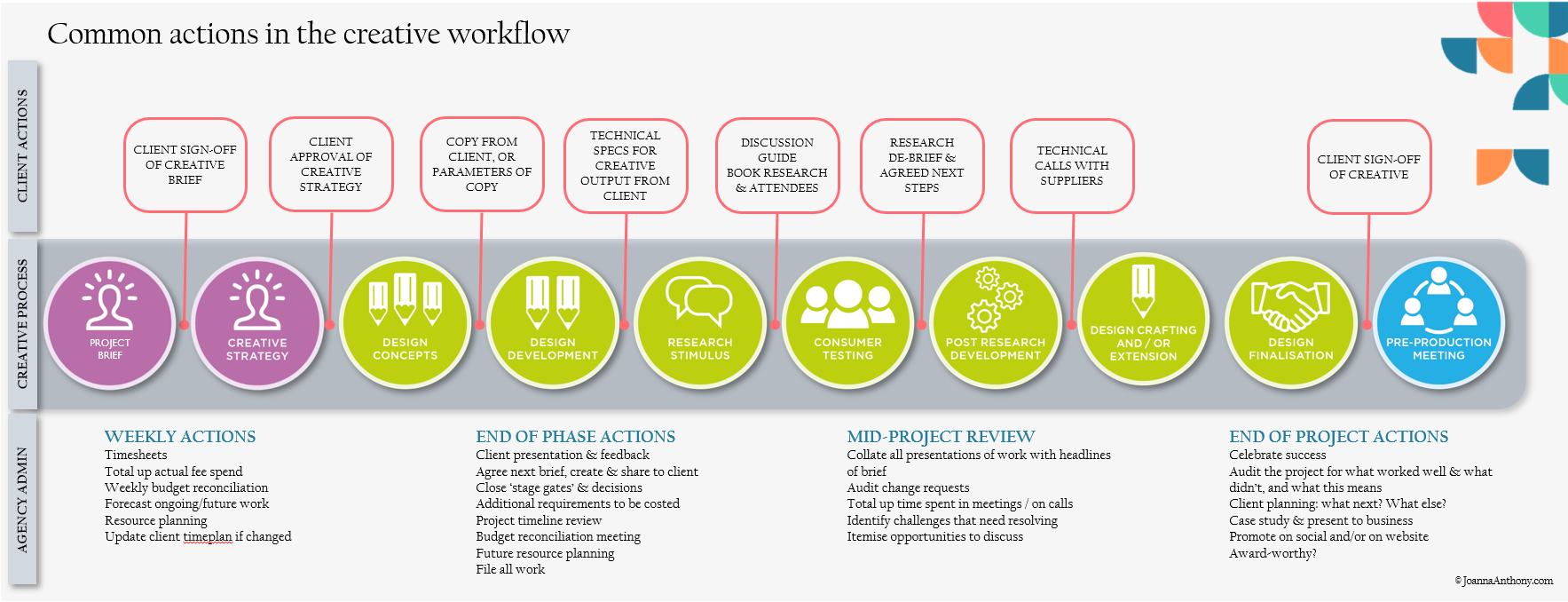
Next step is to get everyone to capture their specific actions, activities, needs, expectations… whatever people feel needs to be included.
A client service person should take it away, distil it to remove duplications, capture the rules and requirements then brief a designer to produce an attractive infographic that brings the workflow to life. Print it out very large and stick it up on a long wall and test it.
Encourage people to their comments – what’s missing, what doesn’t work, how does an action get done, who’s doing it. Each month for the next 3-6 months, tidy it up by making the changes and posting it up the wall again. At a certain point, you will have an established way of working. Simples!
In conclusion
Operational inefficiencies may hide in plain sight, woven into the fabric of daily agency life. However, with a keen ear and a strategic approach, these challenges can be transformed into opportunities for growth and improvement. By acknowledging the nuances of creativity, embracing the negotiation process, and addressing operational inefficiencies head-on, design agencies can chart a course towards enhanced productivity and sustained success.